Global logistics insights and freight updates – PLS

Logistics Insights &
Global Supply Chain News

Container terminal and freight forwarding trends – Premier Logistics

Industry Trends &
Expert Trade Knowledge

0%

Choosing Commercial Warehousing and Storage is no longer about finding the largest building. It is about matching space, technology, people, and risk controls with your operating model. A suitable facility should support accurate receiving, visible inventory, safe handling, flexible dispatch, and predictable costs. Small details matter. A clean dock, labeled aisles, working scanners, and trained supervisors can reveal more than attractive marketing language.

Industry data shows why this decision deserves careful research. Zebra Technologies’ 2024 Global Warehousing Study reports that 73% of warehouse decision-makers plan to increase modernization investment within five years. The same study indicates that many operators expect artificial intelligence to improve task optimization and inventory visibility. MHI’s 2024 Annual Industry Report also identifies workforce capability, automation, and digital integration as important supply-chain priorities. These findings suggest that today’s storage partner must manage both physical goods and reliable information.

Marc Wulfraat, founder of MWPVL International, describes a warehouse as “a factory that produces orders.” That practical view is useful. Every receiving check, storage location, pick, scan, and delivery appointment affects customer experience. When comparing providers, review inventory accuracy, order-cycle performance, system integration, security procedures, insurance coverage, contingency planning, and sustainability reporting. Ask for measurable service-level results, not only promises. No scorecard is perfect. Some data may be incomplete, and facility tours can create an overly positive impression. Independent references, sample reports, and a short pilot can reduce that uncertainty. The right choice is not always the cheapest option. It is the provider that can prove dependable performance as volumes, product requirements, and customer expectations change.
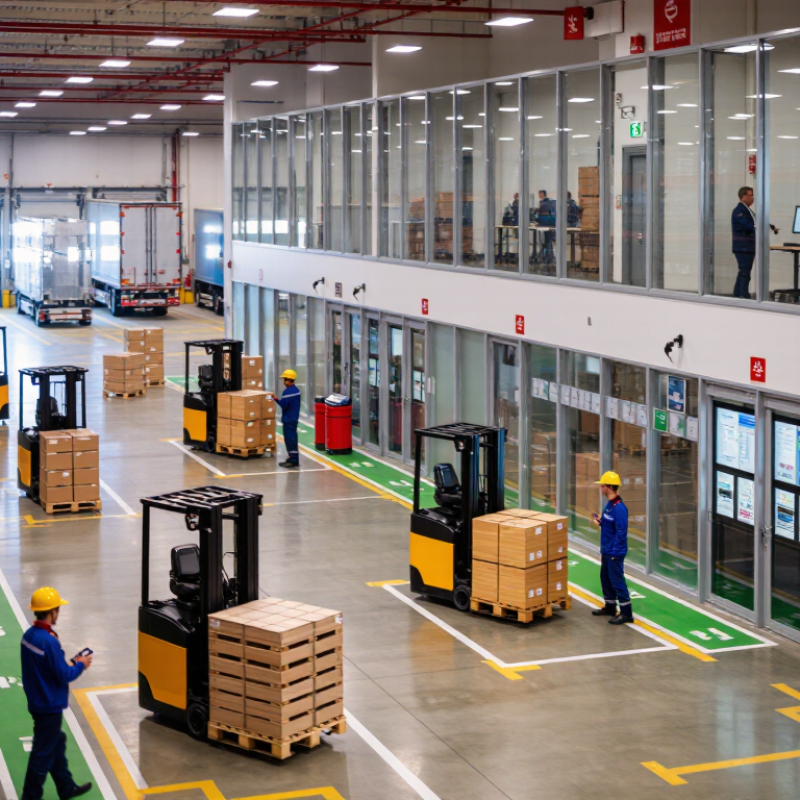
How to Choose Commercial Warehousing and Storage Services?

Forecast Throughput with the 80–85% Warehouse-Utilization Rule

When comparing commercial warehousing and storage services, begin with throughput, not advertised square footage. A facility that looks spacious can still struggle when pallets block aisles or orders wait for put-away. The 80–85% warehouse-utilization rule offers a practical planning boundary. It means using roughly 80–85% of usable storage capacity, leaving room for movement, replenishment, staging, and seasonal surges. Full is not efficient. It is often slow.

To forecast throughput, estimate average daily receipts, picks, replenishments, and dispatches. Then test the busiest week, not only the annual average. For example, 8,000 pallet positions should usually hold about 6,400–6,800 pallets. The remaining space supports safe travel lanes and temporary staging. Yet pallet count alone can mislead. Fast-moving cartons need accessible locations, while slow inventory may tolerate higher-density storage. Ask providers for historical peak handling rates, dock capacity, labor coverage, inventory accuracy, and average dwell time. Request evidence, not optimistic promises.

A useful review also examines layout discipline. Can trucks queue without disrupting outbound work? Are cycle counts documented? Are damaged units isolated and recorded? These details reveal operational maturity. In one planning exercise, I accepted a utilization figure based on floor area. That assumption was wrong; racking, columns, and fire access reduced practical capacity. Recalculate with a site plan and real SKU dimensions. Leave a buffer for growth. A warehouse operating at 92% may appear profitable, but congestion can quietly erase that gain.

How to Choose Commercial Warehousing and Storage Services?

Forecast Throughput with the 80–85% Warehouse-Utilization Rule

The model assumes 100,000 pallet positions and 2.5 inventory turns per month. The highlighted 80–85% utilization range represents a practical planning zone that preserves operating flexibility while supporting strong throughput. Utilization above 85% may increase congestion, handling time, and replenishment delays.

Verify Safety Against OSHA’s 35,000 Annual Serious-Forklift-Injury Estimate

Choosing commercial warehousing and storage services should begin with forklift safety, not shelf capacity. OSHA estimates that forklifts cause about 35,000 serious injuries annually. That figure makes safety verification a practical business requirement. Ask how the facility controls vehicle movement, protects pedestrians, and records incidents. A clean entrance proves very little.

Walk through the operating floor during an active shift. Look for painted pedestrian lanes, visible warning signs, protected rack corners, and working seat belts. Forklift operators should receive documented training and regular performance evaluations.

Ask to review daily inspection forms, maintenance records, near-miss reports, and corrective actions. Check whether loading docks have wheel restraints and whether charging areas remain clear of combustible materials. Small details often reveal larger weaknesses.

Do not accept general promises. Request the warehouse’s written traffic-management plan and emergency procedures. Confirm whether supervisors investigate damaged pallets, fallen loads, and blocked aisles. Ask how temporary workers receive safety instruction. Their answer matters.

A polished tour can mislead, and safety records may contain gaps. That is worth acknowledging before signing a storage agreement. Also verify insurance coverage, inspection schedules, and access controls for stored goods. If the provider cannot explain who reviews forklift incidents, how quickly hazards are corrected, or when equipment is removed from service, the low storage rate may carry an avoidable cost.

Test WMS and Scanning Against a 99.9% Inventory-Accuracy Target

How to Choose Commercial Warehousing and Storage Services?

A 99.9% inventory-accuracy target sounds precise, but it is unforgiving. For every 10,000 recorded units, only ten may be wrong. This tolerance includes receiving, put-away, picking, cycle counts, and returns. WERC’s 2024 DC Measures report places median order-picking accuracy near 99.5%, below this target. The gap is operational, not cosmetic. Choose a provider willing to expose it.

Request a live WMS demonstration using your products, locations, and transaction rules. Test barcode scans during receiving, replenishment, picking, and dispatch. Then remove a label, duplicate a scan, and interrupt the network. The system should reject bad inputs, preserve timestamps, and create an auditable exception record. Measure inventory variance before and after cycle counts. Track scan compliance, adjustment frequency, and resolution time. A polished demo proves little.

Use a controlled pilot with several thousand units and mixed storage conditions. Compare physical counts against system records, not dashboard promises. MHI’s 2024 Annual Industry Report found that 55% of supply-chain leaders planned to increase technology investment, showing strong market confidence in digital tools. Yet software cannot correct careless receiving or unclear ownership. Human workarounds remain a risk. That is the uncomfortable part. Ask how supervisors investigate recurring errors, train temporary staff, and report misses without hiding them. Require weekly accuracy data, sample-count evidence, and corrective-action notes before signing a long-term agreement.

Benchmark SLAs with WERC KPIs: Dock-to-Stock and On-Time Orders

How to Choose Commercial Warehousing and Storage Services?

A reliable warehouse should prove performance with measurable service-level agreements. WERC KPIs offer a practical framework for comparing providers, especially dock-to-stock and on-time orders.

Dock-to-stock measures the time from trailer arrival to inventory availability.

Ask for results by product type, receiving shift, and shipment volume. A strong provider can show timestamped records, not broad monthly claims. Walk the receiving area, too. Look for labeled staging lanes, barcode controls, and clear exception handling. Small delays often begin beside the dock.

On-time orders measure whether shipments leave within the agreed window.

Define the promise precisely: order cut-off, carrier handoff, and acceptable variance. Request at least six months of data, including weekends, promotions, and inventory counts.

A 98% rate may sound excellent, but exclusions can change the picture. Read the SLA carefully. Check how the warehouse handles damaged cartons, short picks, and late inventory updates.

During one site review, a provider reported strong on-time results, yet manual order holds were excluded. That was not dishonest, but it weakened the comparison. We should have asked better questions earlier.

Set review meetings around root causes, corrective actions, and aging exceptions. The best partner shares weaknesses promptly and improves them visibly.

Compare 3PL Total Cost Using Storage, Handling, Labor, and Accessorial Fees

Choosing commercial warehousing starts with a cost model, not a low advertised storage rate. In my warehouse reviews, pallet fees often looked manageable until handling charges appeared. Compare the full 3PL total cost across storage, receiving, picking, packing, labor, and accessorial fees. Ask whether storage is billed by pallet, cubic meter, bin, or daily occupancy. A “monthly” rate may still vary with the number of days stored. Small details matter.

Request invoices from a similar operating month, then rebuild each charge in a spreadsheet. Separate inbound unloading, put-away, order handling, packaging materials, returns, inventory counts, and special labor. Accessorial fees may include appointment changes, oversized cartons, relabeling, weekend work, or rush requests. Check minimum monthly spend, fuel adjustments, peak-season surcharges, and annual increases. Do not assume labor is included. A cheap quote can become expensive when three workers are needed for one manual project. That risk deserves a realistic scenario, even if your forecast feels uncomfortable.

Tips: Measure your last 90 days of orders. Use actual pallet counts and average units per order. Ask for three scenarios: normal, peak, and slow months. Confirm billing triggers in writing, including accessorial definitions and dispute deadlines. Leave room for mistakes. Some costs are hard to predict, especially during product launches or seasonal surges.

How to Choose Commercial Warehousing and Storage Services? - Compare 3PL Total Cost Using Storage, Handling, Labor, and Accessorial Fees

Planning scenario: The comparison uses a standardized monthly operating profile of 1,000 average stored pallets, 1,200 inbound pallet movements, 1,200 outbound pallet movements, and warehouse labor billed separately. Figures are illustrative planning estimates in U.S. dollars and should be validated against each provider’s current rate card and contract terms.
Cost Dimension Calculation Basis Option A
Balanced Service Model
Option B
Lower-Rate Model
Option C
High-Service Model
Average Inventory Stored Pallets per month 1,000 1,000 1,000
Inbound Handling Volume Pallet movements per month 1,200 1,200 1,200
Outbound Handling Volume Pallet movements per month 1,200 1,200 1,200
Storage Fee Monthly rate per pallet $18.00 $15.00 $21.00
Monthly Storage Cost Stored pallets × storage rate $18,000 $15,000 $21,000
Handling Fee Inbound or outbound pallet movement $4.50 $3.75 $5.25
Monthly Handling Cost 2,400 total movements × handling rate $10,800 $9,000 $12,600
Warehouse Labor Estimated billable labor hours per month 80 hours × $32.00 110 hours × $29.00 65 hours × $35.00
Monthly Labor Cost Labor hours × hourly labor rate $2,560 $3,190 $2,275
Accessorial Fees Estimated monthly total $1,800 $2,650 $1,200
Typical Accessorial Items Examples requiring contract review Labeling, appointment changes, pallet rework, cycle counts Peak-season surcharges, special receiving, relabeling, urgent orders Value-added packaging, priority processing, inventory reporting
Estimated Monthly 3PL Total Cost Storage + handling + labor + accessorial fees $33,160 $29,840 $37,075
Estimated Annualized Cost Monthly total × 12 months $397,920 $358,080 $444,900
Estimated Cost per Pallet Movement Monthly total ÷ 2,400 movements $13.82 $12.43 $15.45
Commercial Consideration Primary cost-management focus Balanced storage, labor, and accessorial exposure Lowest modeled total; verify surcharge and minimum-volume clauses Higher base cost; may suit time-sensitive or service-intensive operations
Evaluation checklist: Confirm whether storage is charged on average, month-end, or peak pallet volume; check inbound and outbound handling definitions; review minimum monthly charges; request the complete accessorial schedule; verify labor minimums and overtime rules; and assess annual rate increases, peak-season surcharges, inventory-count fees, and termination provisions before selecting a 3PL partner.

FAQS

Why should forklift safety be checked before storage capacity?

Forklifts cause about 35,000 serious injuries each year. Safety affects people, goods, insurance, and business continuity. Capacity comes later.

What should I inspect during an active warehouse shift?

Look for painted pedestrian lanes, warning signs, protected rack corners, and working seat belts. Watch traffic, not just cleanliness. A clean entrance proves little.

Which safety records should a warehouse provide?

Request training records, daily inspection forms, maintenance logs, near-miss reports, and corrective actions. Ask who reviews incidents and when hazards are corrected.

How can I test a warehouse traffic-management plan?

Request written traffic and emergency procedures. Check loading-dock wheel restraints and clear charging areas. Ask how temporary workers receive safety instruction.

How should inventory accuracy be tested?

Use a live system demonstration with your products and location rules. Test receiving, replenishment, picking, dispatch, and returns. Then interrupt the network.

What system behaviors indicate strong inventory control?

The system should reject duplicate scans, preserve timestamps, and create exception records. Compare physical counts with system records. Dashboards alone are weak evidence.

Is a 99.9% inventory-accuracy target realistic?

It is demanding. For 10,000 units, only ten errors are allowed. A controlled pilot with several thousand mixed units reveals practical weaknesses.

Which warehouse service levels should be written into an agreement?

Define dock-to-stock time and on-time order performance precisely. Include cut-off times, carrier handoff, weekends, promotions, and acceptable variance.

What hidden details can distort warehouse performance data?

Some reports exclude manual order holds, damaged cartons, short picks, or late inventory updates. Read every exclusion carefully. We should ask earlier.

How can a provider prove reliable performance?

Request at least six months of timestamped data. Review aging exceptions, root causes, and corrective actions. Strong partners share weaknesses promptly. Not just polished results.

Conclusion

Choosing the right Commercial Warehousing and Storage provider requires more than comparing monthly rates. Begin by forecasting inventory volume, order frequency, and seasonal demand, while keeping expected warehouse utilization near 80–85% to preserve room for receiving, picking, and unexpected surges. Safety should also be verified through equipment-training records, site inspections, incident reporting, and controls designed to reduce forklift risks, especially in light of the estimated 35,000 serious forklift injuries reported annually.

Technology and service performance are equally important. Test the warehouse management system, barcode scanning, cycle-counting procedures, and reporting capabilities against a practical inventory-accuracy target of 99.9%. Request measurable service-level data, including dock-to-stock speed, order accuracy, and on-time shipment rates, using recognized logistics performance indicators. Finally, compare the complete 3PL cost rather than storage prices alone. Include handling, labor, receiving, picking, packing, transportation coordination, account access, and other accessorial fees to determine which provider offers reliable performance and transparent long-term value.

Amelia

Amelia

Amelia is a dedicated marketing professional with a strong understanding of the company’s products, customers, and industry landscape. With a talent for transforming complex information into clear, practical insights, she regularly contributes expert articles to the company website’s professional......